
Law Office / Closed file retention and destruction log (New York)
Free
Closed File Retention and Destruction Log
Which closed file can go, when, and the proof that it went.
Get the workbook
Tell us where to send it and the download starts on this page.
Works in Excel 2016 or later, Google Sheets, LibreOffice and Numbers. No macros and no add-ons.
Scroll the sheet sideways to see all of it.
What it does
One row per closed file, and a permanent record of every file destroyed. You type the retention period you choose and the date it starts. The sheet works out the earliest review date from your own period, and shows it beside the file. It never fills in a period for you, and it never says a file may be destroyed.
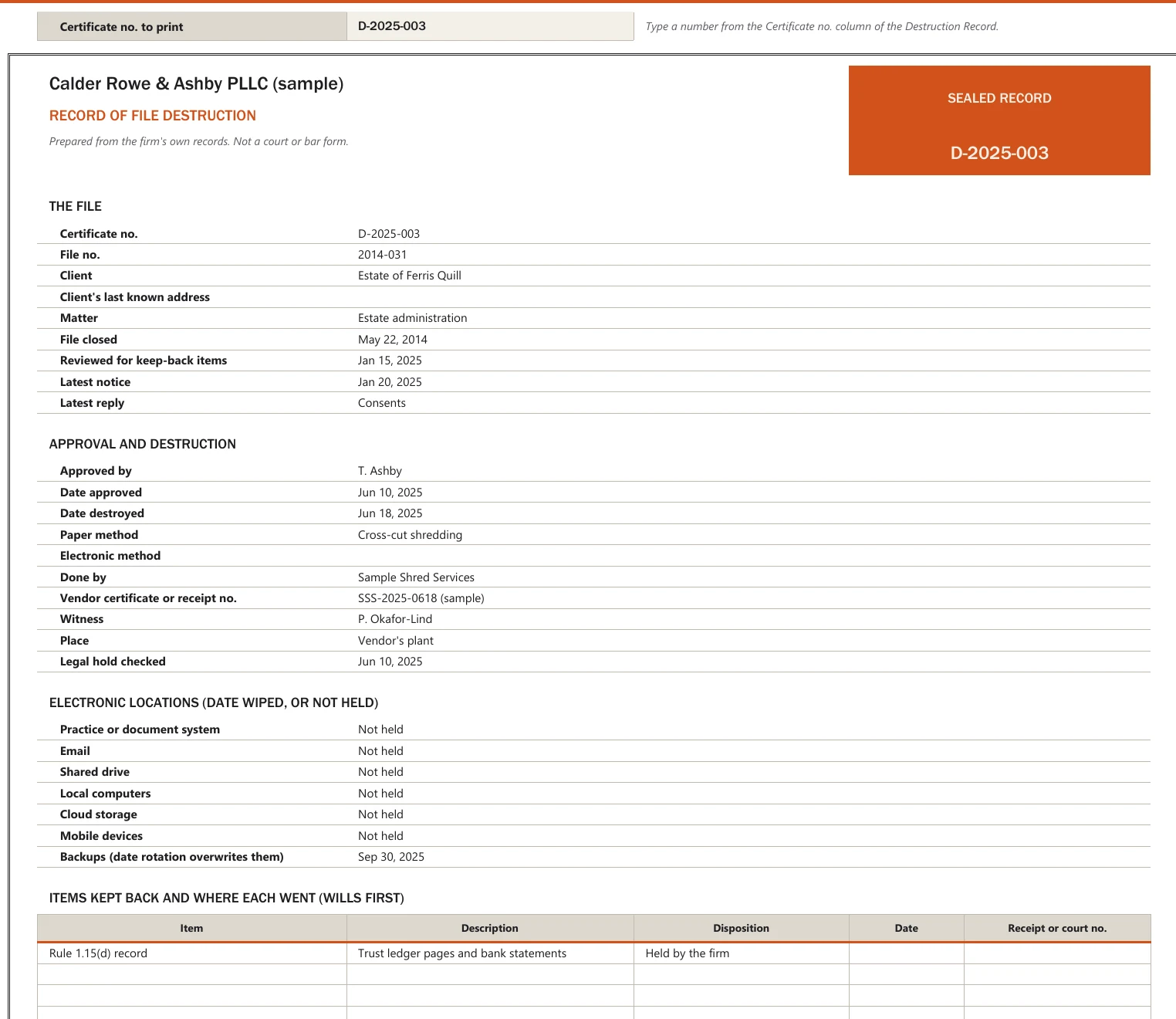
The destruction side is the half most policies leave out. A file that goes needs a record of what was destroyed, when, by whom, by what method, who witnessed it and where, and that record has to outlive the file. Each one gets a certificate number and prints from the Certificate tab.
The ten tabs
| Tab | What is on it |
|---|---|
| Start Here | What the file is, what it leaves to you, how each tab works, the sample data and the colour key. |
| Files | One row per closed file: the matter, who it was for, the dates, where it is stored, the period you chose, the date that starts it and the earliest review date. |
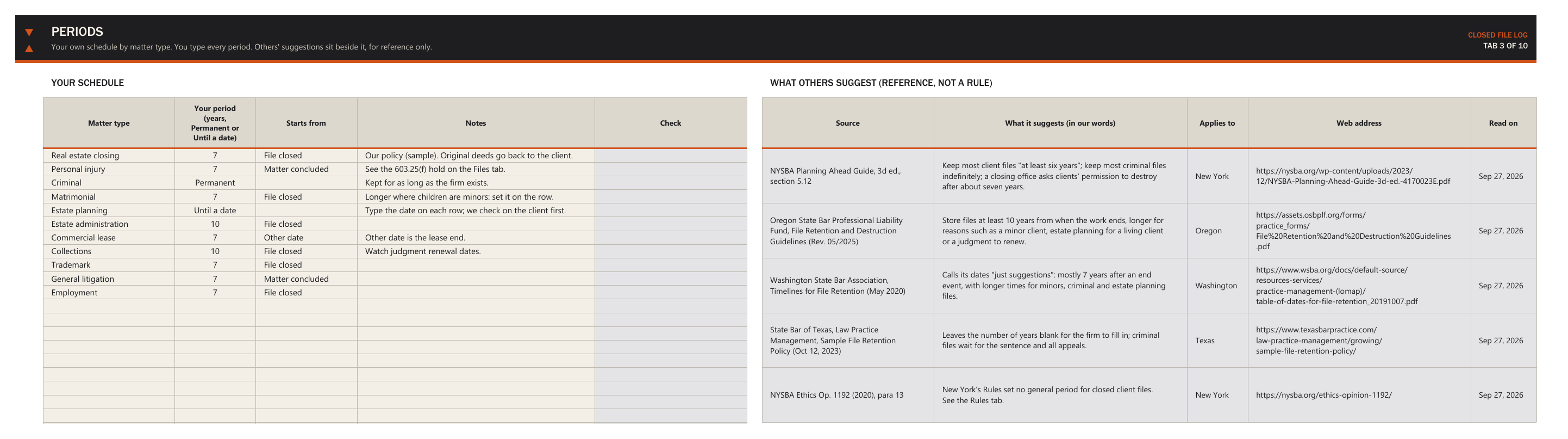
| Periods | Your own schedule by matter type, if you want one, with what some bar guides suggest beside it for reference. |
| Keep Back | Original wills, deeds, client property, Rule 1.15(d) records and anything else that must not go with the file, and where each one went. |
| Notices | Every notice about a file, how it was sent, its reply-by date and the reply. |
| Destruction Record | One row per destroyed file, kept for good: what, when, by whom, by what method, who witnessed it, where, and its certificate number. |
| Certificate | The certificate for any destruction record, laid out to print. |
| Register | Every destroyed file in date order. |
| Rules | The New York rule text quoted in full, with its source and the date it was read. |
| Dashboard | What is open, what is coming up for review, and what has gone. |
cream cells are yours to type ingrey cells are formulassand bars separate the sections
Where the rule text comes from
The Rules tab quotes the text rather than summarising it, with a link to the source and the date it was read. A few of the ones that decide how the rest of the workbook behaves:
-
Rule 1.15(d)(1)
A lawyer shall maintain for seven years after the events that they record: (i) the records of all deposits in and withdrawals from the accounts specified in Rule 1.15(b) ...
New York Rules of Professional Conduct. This is why those records are kept back rather than destroyed with the file. -
NYSBA Ethics Opinion 1192, paragraph 16
the law firm must keep a record for some undetermined period of the scope of an earlier but now-closed representations.
Rule 1.10(e) imposes no time limit on retaining the conflict record. Destroying a file never removes its names from it, which is why the Register is permanent.
Quoted from the sources named on the Rules tab. Read them yourself before you rely on them.
What it is not
An organiser, not legal advice. Not made by, approved by or connected with any court, bar association or government office.
- It never decides that a file may be destroyed. That decision is the lawyer's.
- It never fills in a retention period for you. You choose each one.
- The rule text is New York. The structure works anywhere; the quoted periods do not.
- The sample firm, clients and files are made up. Type over them, or clear the cream cells to start empty.
- Never delete rows from the log. It is the permanent record.
Take it
Free, for use within one firm. A single workbook you download once and keep, with nothing to install and no subscription.
Questions: contact@northlineoffice.com
More from the Law Office: Case Deadline and Discovery Tracker, Billable Hours and Invoice Log, Client Trust Account Ledger (New York), Executor Estate Inventory and Ledger, Medical Records Request and Chronology Log, Settlement Disbursement Sheet (New York), Law Firm Client Intake and Conflict Check Log, Successor Trustee Accounting Ledger, Deposition Tracker and Summary Log, Power of Attorney Agent Ledger (New York)