
Law Office / Executor estate inventory
Executor Estate Inventory and Ledger
Everything the estate owned, and every dollar in and out, kept straight. A workbook for the person handling an estate, and for the paralegal who helps them. List what the person owned with its value on the date of death, then record what was sold or collected, what came in, what was paid, the debts and claims, and what each beneficiary received.
With a New York crosswalk. Works in Excel, Google Sheets, LibreOffice and Apple Numbers. No macros.
Scroll the sheet sideways to see all of it.
Principal and income, kept apart
Principal is what the person owned and what it sold for. Income is what it earned after death: interest, dividends, rent. Each expense and distribution says which one it comes out of (principal if you leave it blank).
On the New York accounting form, principal received is Schedule A, and interest, dividends and rent collected go on Schedule A-2. The Balance tab keeps the two apart line by line, and the NY Crosswalk shows where each figure sits, to help prepare the forms.
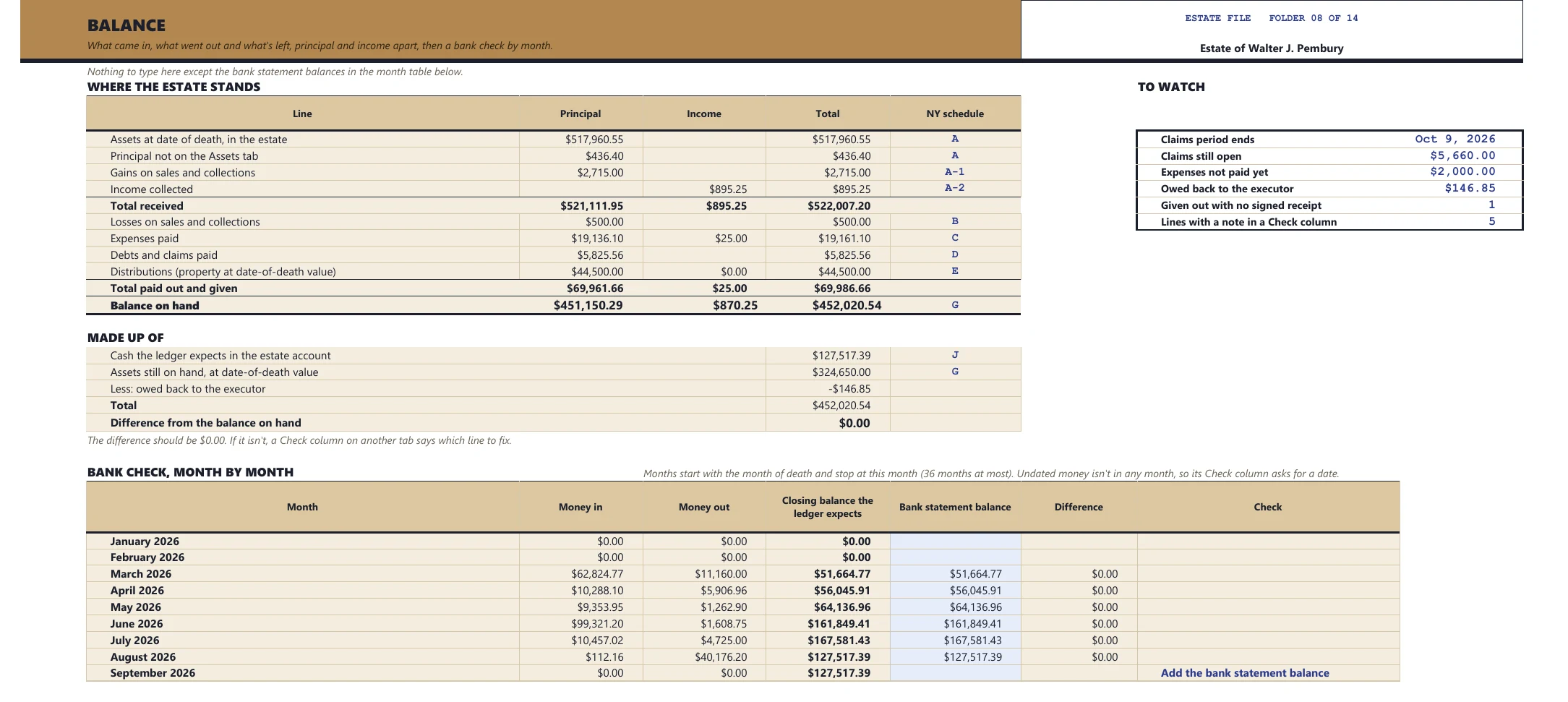
The form's summary: received (A, A-1, A-2) less paid out and given (B, C, D, E) equals the balance on hand shown by G. The Balance tab keeps the same shape.
Where the estate stands
| Line | Principal | Income | NY schedule |
|---|---|---|---|
| Assets at date of death, in the estate | $517,960.55 | A | |
| Principal not on the Assets tab | $436.40 | A | |
| Gains on sales and collections | $2,715.00 | A-1 | |
| Income collected | $895.25 | A-2 | |
| Total received | $521,111.95 | $895.25 | |
| Losses on sales and collections | $500.00 | B | |
| Expenses paid | $19,136.10 | $25.00 | C |
| Debts and claims paid | $5,825.56 | D | |
| Distributions (property at date-of-death value) | $44,500.00 | $0.00 | E |
| Total paid out and given | $69,961.66 | $25.00 | |
| Balance on hand | $451,150.29 | $870.25 | G |
From the Balance tab of the sample estate, which is made up.
Values go on the Inventory of Assets as letters
Under 22 NYCRR 207.20, each value is shown as a letter from A to G. The Assets tab puts the letter beside every date-of-death value for you.
| A | $0 to under $10,000 |
|---|---|
| B | $10,000 to under $20,000 |
| C | $20,000 to under $50,000 |
| D | $50,000 to under $100,000 |
| E | $100,000 to under $250,000 |
| F | $250,000 to under $500,000 |
| G | $500,000 and over |
What's in the file
Fourteen tabs, one folder each. Blue cells are yours to type in. The kraft cells are formulas: leave them alone and they stay right.
- 01 Start HereThe estate's details, the date letters were issued, and the claims period you've been told to use. The sheet shows the date that period ends, for you to watch.
- 02 AssetsEverything the person owned or that pays to the estate, one line each, with its value on the date of death. How it passes tells the sheet whether it's part of the estate, and the NY letter beside the value is the A to G band from the New York Inventory of Assets form.
- 03 Sold or CollectedWhen an asset turns into money (the house is sold, a bank account is closed into the estate account, an insurer pays), add a line with its tag. You'll see the gain or loss against the date-of-death value.
- 04 Money InMoney that isn't an asset on the list: interest, dividends and rent (income), or something found later, like a refund (principal).
- 05 Money OutFuneral, court fees, the lawyer, utilities and the rest. Leave the date blank until it's paid. If you paid out of your own pocket, say so, and add the date the estate paid you back.
- 06 Debts and ClaimsEach bill or claim against the estate, how it arrived, its status and what's been paid. The status is yours to pick; the sheet doesn't decide whether a claim is valid.
- 07 DistributionsMoney or property given to each beneficiary, who received it, and whether a receipt and release was signed. A cash payment bigger than the cash on hand that day is flagged.
- 08 BalanceWhat came in, what went out and what's left, with principal and income kept apart. Then, month by month, the cash the ledger expects beside your bank statement.
- 09 Still on HandAssets not yet sold, collected or given out, and the cash.
- 10 TasksThe usual jobs, in order. Type the dates you're given or choose. The sheet doesn't work out legal deadlines.
- 11 Tax FormsNames of forms an executor often hears about, with a status for each. It doesn't say which ones apply.
- 12 ContactsThe lawyer, accountant, bank, insurers and family, in one list.
- 13 Online AccountsAccounts and subscriptions to cancel, close or keep. Never write passwords in this file.
- 14 NY CrosswalkFor a New York estate: where each figure sits for the Inventory of Assets and the accounting schedules A to K, to help prepare them. It isn't the form. The court's forms are free at nycourts.gov.
Every formula was checked before it went on sale. A separate program read only the blue input cells and worked out every formula cell again from scratch: the value letters, gains and losses, principal and income totals, what's still open, the balance on hand, the bank check by month and the crosswalk figures. Then it compared its answers with the spreadsheet's own, cell by cell.
It ran again on a second test file full of awkward cases, such as values on each A to G line and a cent below it, a debt paid in part, a distribution far bigger than the cash on hand, a sale below the date-of-death value, text typed where a date belongs, and a bank balance off by 15.00. That file came back with 7,708 checks and no mismatches. Neither file had a single error cell.
This file holds family and money details. Use the last 4 digits of any account, and keep the file somewhere safe.
Questions
Does it work in Google Sheets?
Yes. Upload the file to Google Drive, then open it. Everything works there too. It also opens in Excel, LibreOffice Calc and Apple Numbers. No macros and no add-ons.
Is it only for New York estates?
The New York parts are the value letters on the Assets tab and the NY Crosswalk. The claims period is yours to set: New York counts 7 months from letters (SCPA 1802). Other states use other periods. Check yours.
Does it work out commissions, taxes or deadlines?
No. The sheet doesn't work out executor commissions, taxes or legal deadlines. You type the facts and it keeps them straight.
I paid an estate bill out of my own pocket.
Say so on Money Out, and add the date the estate paid you back. The Balance tab keeps what's still owed back to the executor.
How much room is there?
120 assets, 80 sales or collections, 200 money-in lines, 250 money-out lines, 60 claims, 80 distributions and 36 months of bank checks.
Is there a subscription?
No. It's a one-time $4.99 download, for one estate per purchase. You keep the file.
What if something doesn't work?
Email contact@northlineoffice.com and include your order email. Typical response within 2 business days.
Please note
- Digital download. Nothing is shipped.
- No macros, no add-ons, no subscription.
- An organiser, not legal or tax advice. The court's own forms and your lawyer decide what is filed. It isn't a court form, and it doesn't work out commissions, taxes or deadlines.
- The sample estate, family and firms are made up.
License: personal use, or use for one estate per purchase. No resale or sharing of the file.
The whole estate, in one file
A one-time download, for one estate per purchase. Digital file, nothing shipped, no subscription.
Sold through Gumroad. Questions before you buy: contact@northlineoffice.com
Excel, Google Sheets, LibreOffice, Numbers
More from the Law Office: Case Deadline and Discovery Tracker, Billable Hours and Invoice Log, Client Trust Account Ledger (New York), Medical Records Request and Chronology Log